
 Steve Bradley
 Shortly after arrival in Canada we initiated our plans to make changes so we can plug into North American shore power and procure and refill propane tanks.
Shore power in North America
Fortunatley Canada and the USA share the same specifications for AC Shore Power and the standard voltage in North America is 120 volts (V) at 60 hertz (Hz). However, there are other voltages in use including:
- 110 115 & 125V: Are still used in some locations.
- 240 V and 250V : A voltage that is available in most homes through a split-phase system that also provides 120 V. This can also be found in marinas and commercial harbours.
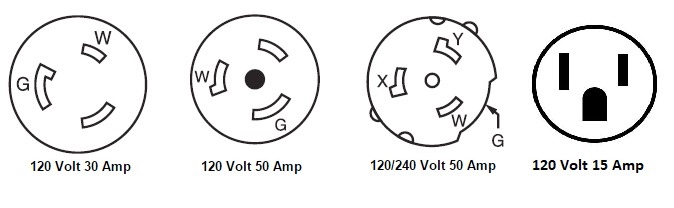
To add a little more confusion there are often a few different socket outlets on the dock that can all deliver 120V, these are the most common:
In Europe and the UK the standard voltage is 230 volts (V) at 50 hertz (Hz). However using the UK as an example the voltage tolerance is -6% to +10%, which means the voltage can range from 216.2 V to 253.0 V and you will often see voltages on appliances expressed as 220 V 230 V and 240 V.
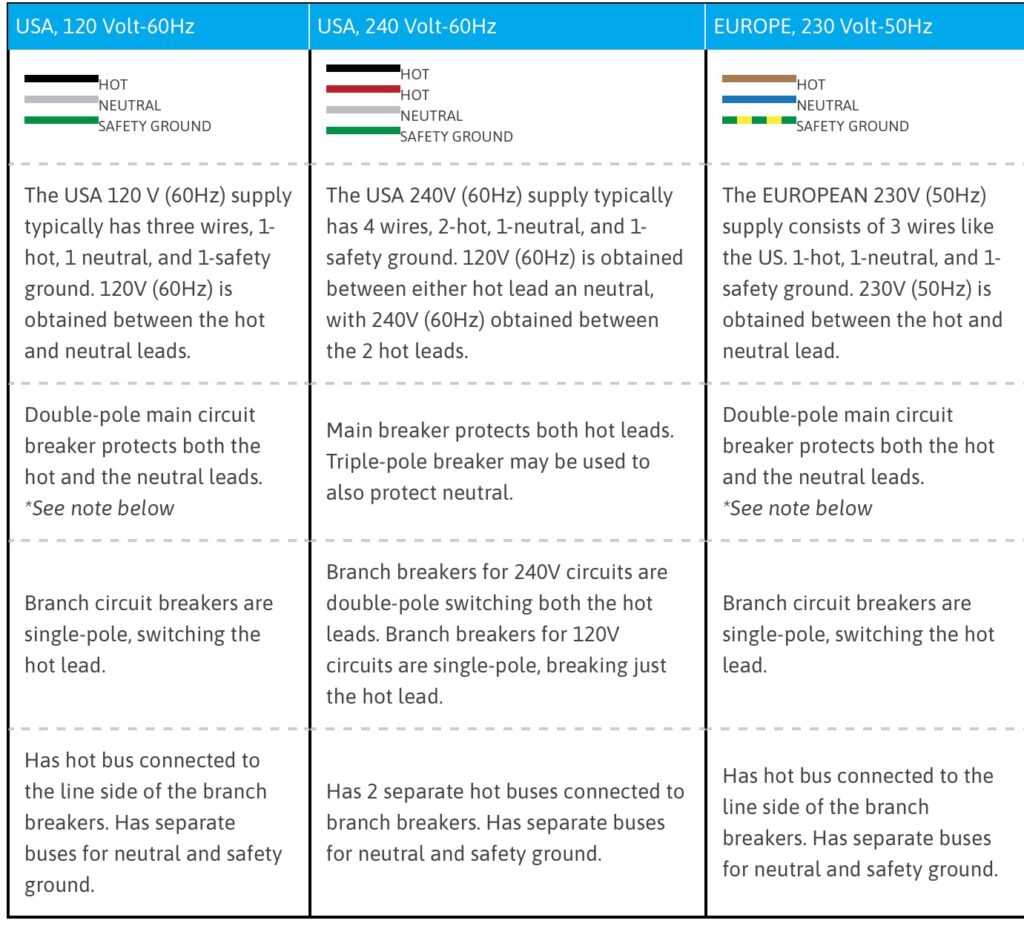
The following table, courtesy of Blue Sea Systems sets out the differences between the three different AC supplies we are planning to use, and the colour coding and installation requirements, its also important to fully understand the wiring specification for the chosen supply as you will need larger cables for for any given wattage. For supplying 3600 Watts of power a typical 16A 230V shore power cable will be 14AWG (2.5mm2) whereas a 30A 120V cable will be 10AWG. (6mm2)
The 240 volts (V) at 60hertz (Hz) supply can be adapted to 120V by wiring to just one of the hot pins, plus a neutral and ground in a similar way to wiring to a single phase of a there phase supply in the EU/UK.
There are several conversion options for a EU boat, ranging from simply adding a 120V charger and using the inverter for AC circuits to completely rewiring and replacing all appliances for 120V.
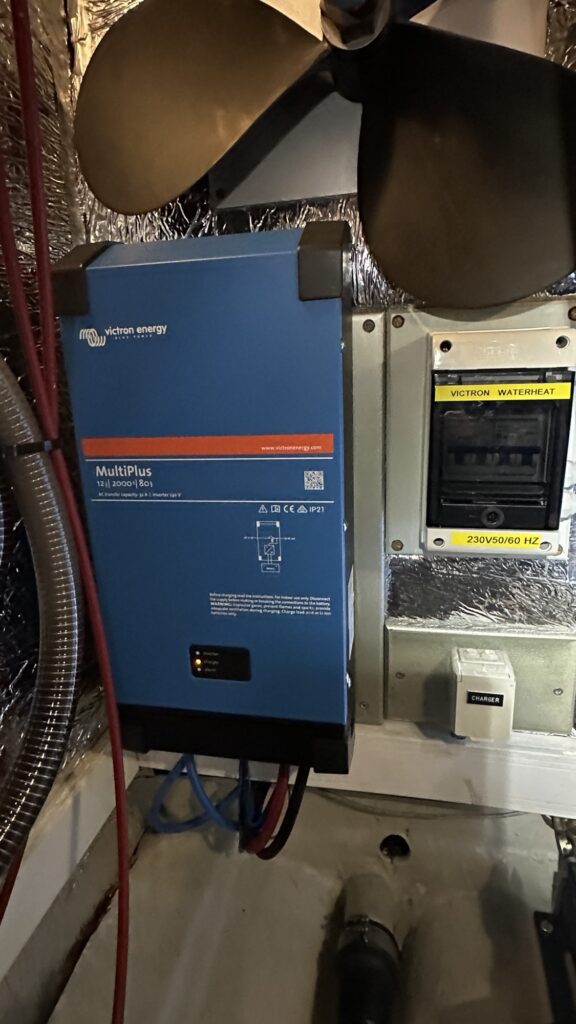
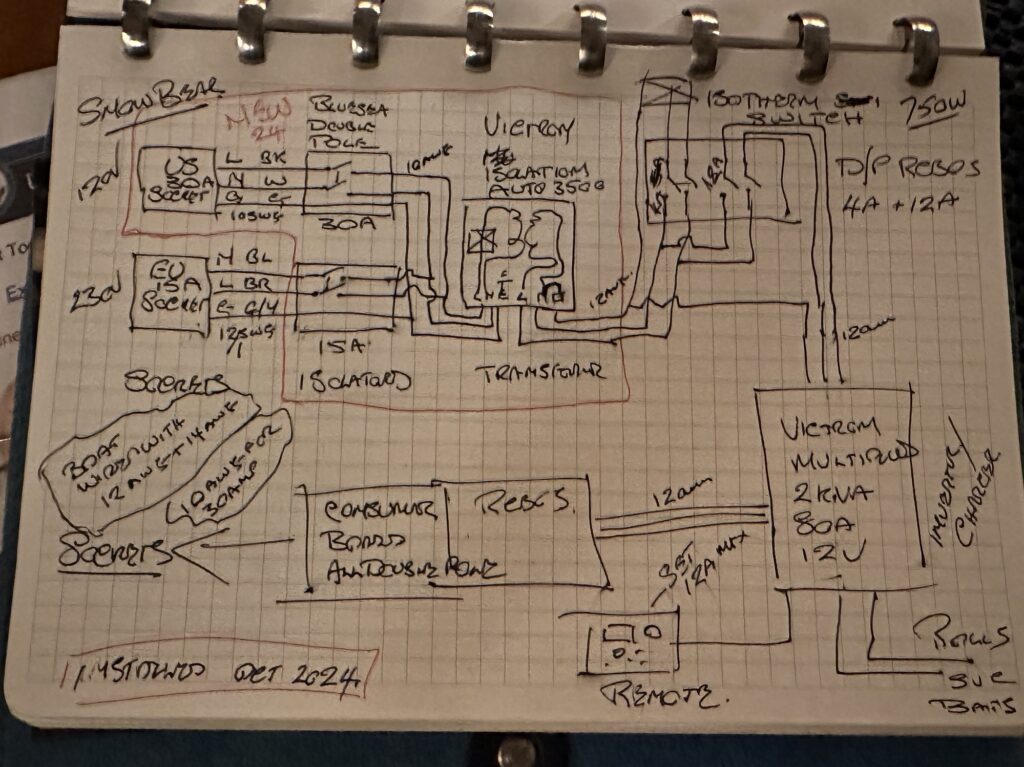
Since we live aboard in colder climates, we sought a more integrated solution that isolates the boat’s electrical systems from shore power while accommodating both US 120V and EU 230V supplies. In the UK, we upgraded Snow Bear’s AC wiring by installing a Victron Multiplus 80A 2KVA inverter and ensuring all main and branch circuits had double-pole isolators. These isolators feature RCBO/GFCI protection against electrical shock and overcurrent.
Additionally, we directed the shore power supply to the hot water system upstream of the inverter, preventing service battery drain. We chose AC appliances compatible with both 50Hz and 60Hz.
Upon arriving in Canada, the boat was equipped for 230V 50Hz with a 16A European shore power socket, ready to accept a 60Hz supply at a similar voltage.
The conversion
Before our arrival into Lewisporte we ordered the parts for delivery that we would need including; 30A shore power cables, various adaptors, a new 30A inlet socket for the boat, Blue Sea 30A double pole isolator, a few meters of 10AWG marine grade cable and the transformer.
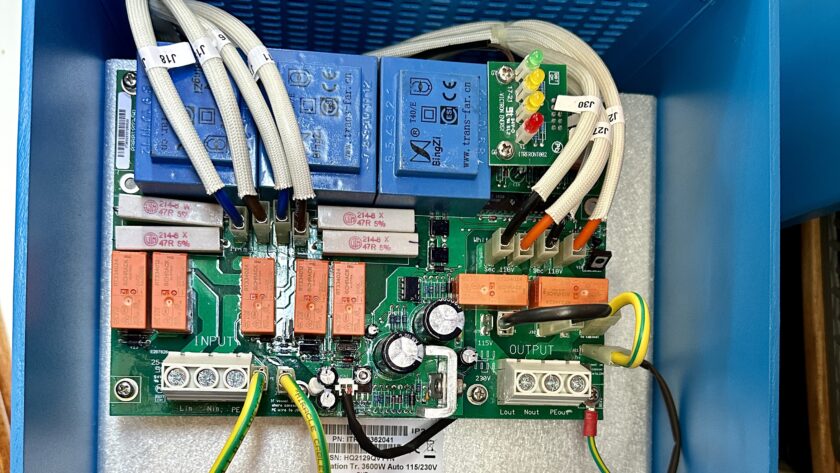
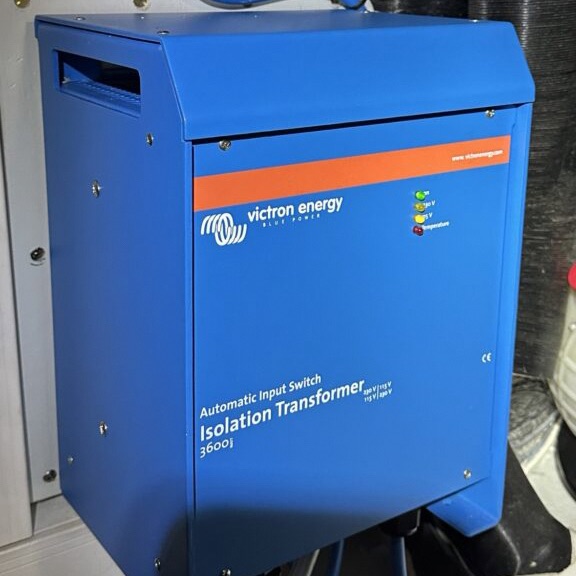
A little research had led to the purchase of a Victron 3600w isolating transformer. We chose the auto version as this model automatically switches input to accommodate either 120V or 230V. Whilst keeping the output at a constant 240v:
- The isolation transformer converts the input voltage with a 1:1.05 ratio. The 1:1.05 transformer ratio boosts the output voltage of the isolation transformer by 5%. This is to compensate for shore power voltage drops that are a common occurrence in marinas.
- The isolation transformer will automatically detect the incoming voltage and will switch to a 120V or 230V AC input configuration, depending on the input voltage:
- If the incoming voltage is between 88 and 130V, the transformer switches to 120V input mode.
- If the incoming voltage is between 185 and 250V, the transformer switches to 230V input mode.
- The isolation transformer can be used in 50Hz or 60Hz systems. However, the isolation transformer cannot convert frequencies from 50Hz to 60Hz or vice versa.
- The isolation transformer can be used in 120V or 230V systems and also be used to convert 230V to 120V and 120V to 240V depending on how you configure it, so this would also work well in converting a US boat for EU shore power.
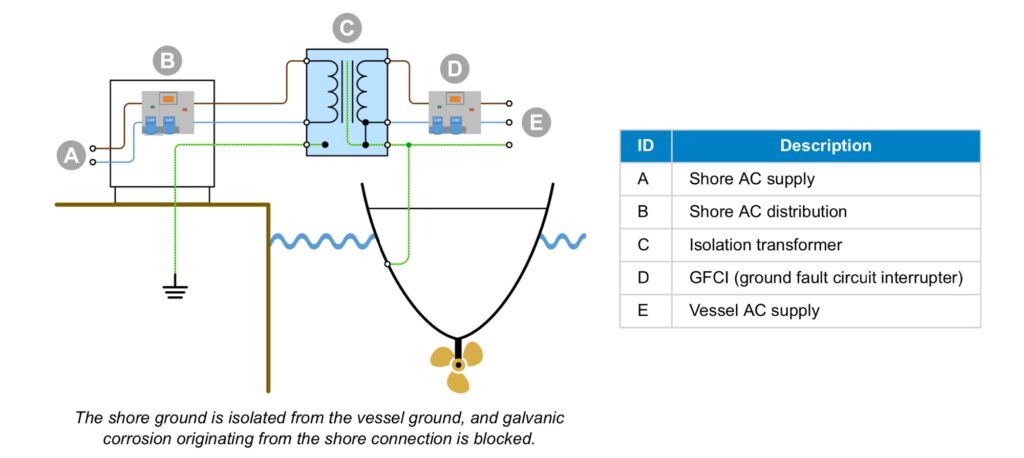
- The Isolation transformer offers the best solution to prevent galvanic corrosion
We started by installing the new 120V 30A shore power socket in the cockpit wired in parallel with the EU socket and fitted appropriately sized double pole Blue Sea isolators in our engine room to both incoming supply cables, the outputs from the isolators both go to the Isolation transformer input.
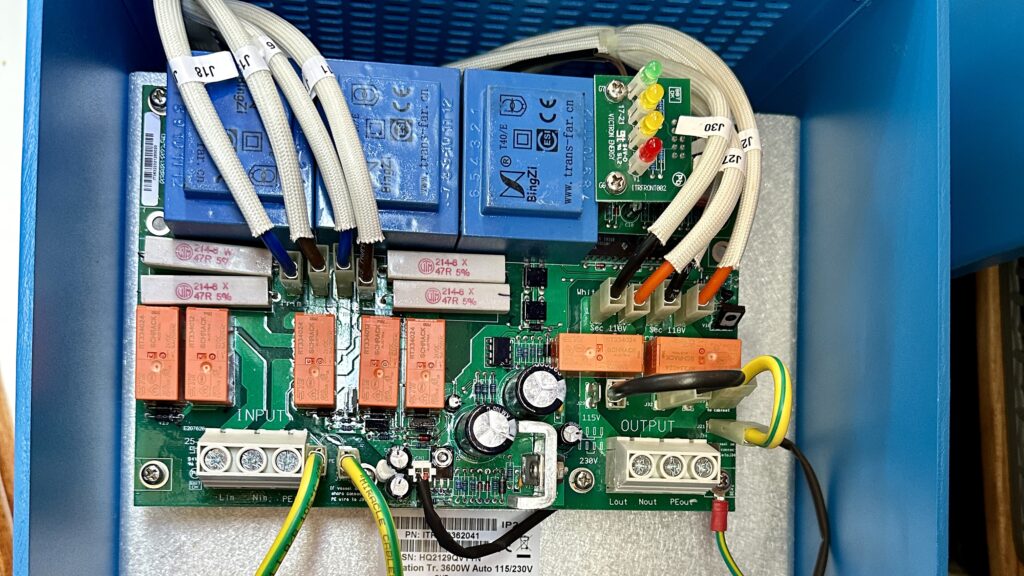
We installed the 20KG transformer in our engine room, bolted to a backing board that we procured from the maintanance team at Battle Harbour and painted with some great bilge paint.. We then configured it for the correct voltages and auto operation with the jumper cables following the simple installation instructions, and connected the outlet to our services isolator.
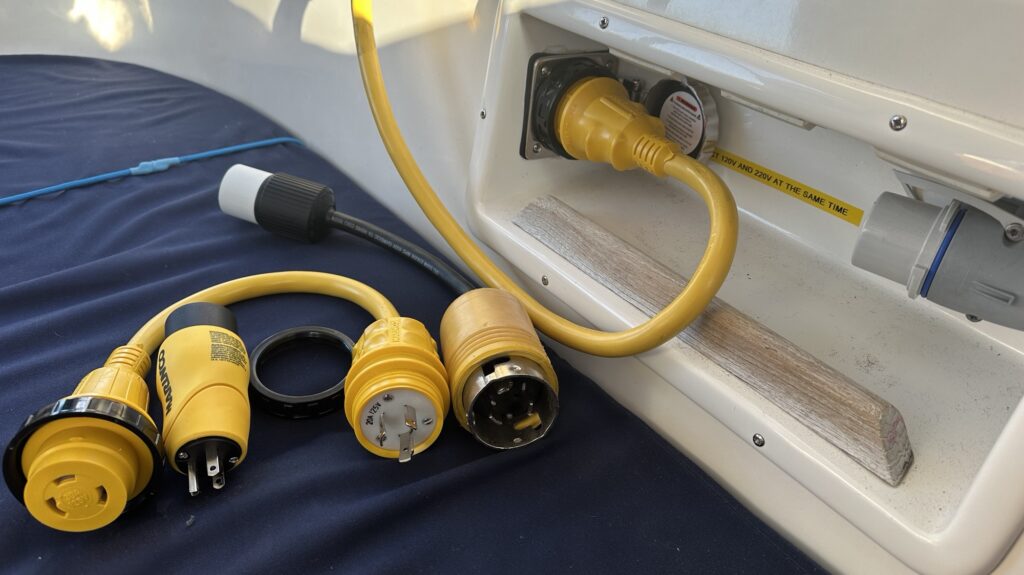
There are a few different marina sockets to contend with, 15a, 20A, 30A, 50A so we needed to buy or make up a few adaptors and we needed a couple of 50 foot cables.
With the Isolation transformer in place the boat is fully isolated from the shore supply. The boats neutral is bonded to ground using the supplied jumper cable inside the Victron transformer. It’s recommended that should the boat be stored and powered ashore, then the boats ground should be bridged to the shore ground. There is a jumper wire supplied to connect this when needed.
The remote panel on our multiplus allows us to set the current correctly to match the available shore power Amps. And the multi plus power-assist kicks in if it goes over the set current, you can read more about the power-assist feature here
We spent time testing and checking voltages, polarity, and frequency and ensuring the isolators were tripping, as they should do, before connecting anything to the output of the transformer. We continued testing as we connected the multiplus and plugged in various appliances.
In addition to connecting to a few different shore power sockets in Canada, we have test run our UK suitcase generator feeding 220v 50Hz into the EU socket and it works fine.
Whilst it’s not recommended to run 50Hz appliances on 60Hz or visa versa, we are not having any issues with what we have onboard including:
- Victron Multiplus 2000VA 80a Inverter/Charger
- Isotherm 750w Hot water calorifier
- Panasonic microwave
- Panasonic bread maker
- Krupps coffee maker
- Dualit Kettle, Toaster and coffee Grinder.
- Dimplex fan heaters
- Meaco dehumidifier
- Various chargers and adaptors.
- Tapo smart plugs
- Single Induction Hotplate
The end result is a system that works perfectly! We can plug the boat into the various supplies found in the US, CA, UK, EU and most of the rest of the world without making any changes or adjustments to anything in the boat.
Propane conversion
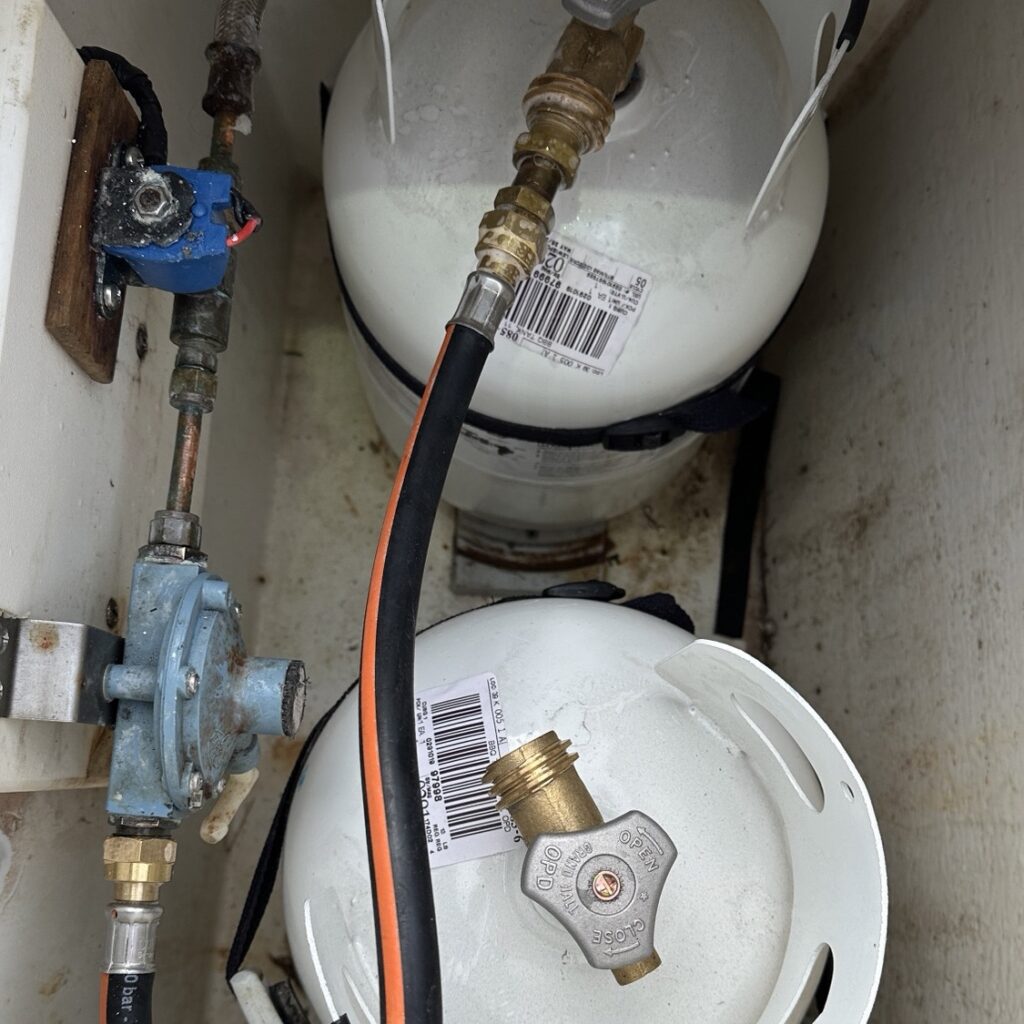
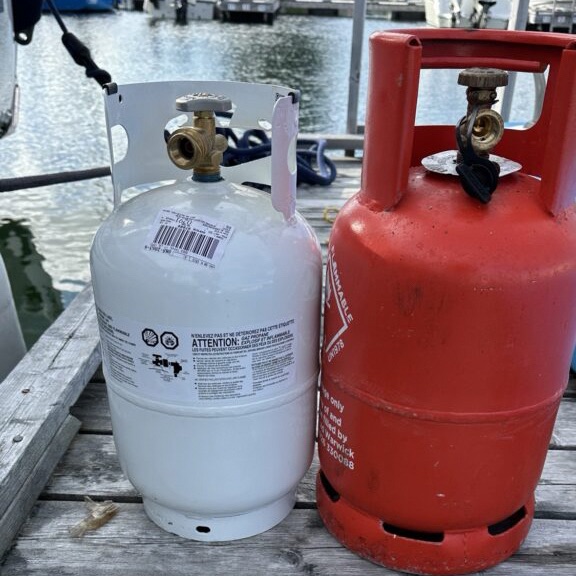
We also needed to adapt our propane system to utilize the refillable cylinders widely available in North America. To facilitate this transition, we had already sourced adaptors for the North American standard, making the conversion straightforward. The key change involved replacing the UK POL fitting with the US POL fitting. While they may appear similar at first glance, the two fittings have slightly different screw threads, and the US version features a rubber seal for added safety.
To complement this adaptation, we sourced a couple of 11-pound refillable propane cylinders that fit perfectly in our gas locker. These cylinders are convenient and compact, providing ample fuel for our cooking and heating needs aboard. After installing the adaptors, we took the cylinders to a local gas station where they could be easily filled—an economical choice compared to propane prices in the UK..
Discover more from Snow Bear Adventures
Subscribe to get the latest posts sent to your email.
This is great help! The most clearly written description of “European boat to Americas boat” conversion I ever read. Thank you!(Najad 391 owner here..). Happy New Year!
Thanks you, I’m glad you found it useful, the power conversion is certainly working really well in all the locations we have been too.. I was a little concerned that I might have made a mistake with the gas because a few posts I read after buying the bottles said refilling was difficult in US, but we have just refilled one in Portland at U-Haul.. very quick and simple😊
Hey Steve, thanks so much for this post very useful to me and a lot other sailors on the same route. One quick question. Your solution for shore power in North America is the right one, but on our 33 footer I really want to avoid putting a heavy bulky isolation transformer. I was hoping to get away with making a cable to connect to the 240V 50A split phase shore power on one side and to the 220 V inlet of my boat, which should be able to handle 60 Hz. Hence, avoiding the 110V conversion.
I wanted to ask you, how common is to find in Canadian marinas shore power outlets with the 240V split-phase?
Hi Stefano
Some do take this approach, what you need to consider however is that whilst using the split phases in the way you suggest will give you the voltage, there is a significant safety risk because they are both live phases.
In a uk or Europe 220-240 v supply only the live is live, the neutral is grounded.. measuring voltages between earth and live and earth and lave and earth you will get 220-240v.. measure neutral to earth you should get 0v
A us/canadian split phases supply has two opposite phase 120v lives, a neutral and an earth.
So connecting across the two lives will give you your 240v (it’s actually a bit less) but now if you measure between earth and your neutral it will show 120v. So this could create a risk of electric shock with any appliance if the neutral is exposed in any way.
It may also cause issues with some types of RCD type circuit breakers.
And it will not be compliant with either EU or US electrical installation standards, so will probably void your insurance.
Split phase supplies are available in harbours marinas.. not everywhere but fairly common.. but you need to also consider that marinas will charge you more, sometimes double for plugging into a 50a split phase supply as they usually charge a flat daily rate rather than anything that’s based on consumption.
All depends on what you are using onboard though.